
How Can You Source Low-MOQ Lamination Decorative Film with 48-Hour Samples—Without Renovation Stress?
- Giwett

- Dec 17
- 5 min read
Updated: 1 day ago
Why Home Stagers Choose Decorative Lamination Film for “High-Impact, Low-Drama” Upgrades
When a listing feels dated, it’s rarely the sofa—it’s the doors, cabinets, and worn furniture faces that ruin the photos. Replacing them is expensive, slow, and messy. Lamination decorative film (also called decorative lamination film / PVC decorative film / furniture wrap film) helps you refresh surfaces without demolition, so you can stage faster, control costs, and avoid contractor delays. The real stress isn’t applying film—it’s sourcing: minimum order quantity, sample speed, roll width, install method, and whether the supplier can back quality with documentation.

The 5 Film Styles That Cover Most Staging and Fit-Out Applications
1) Wood Grain Decorative Film
Look & pattern: Natural grain flow, knots, plank rhythm, warm-to-neutral tones (oak, walnut, ash).Best for: Interior doors, cabinet faces, wardrobes, shelving, tables, reception desks.Why it works: Instantly removes “orange glossy” finishes and photographs warm and premium—especially in matte/satin.

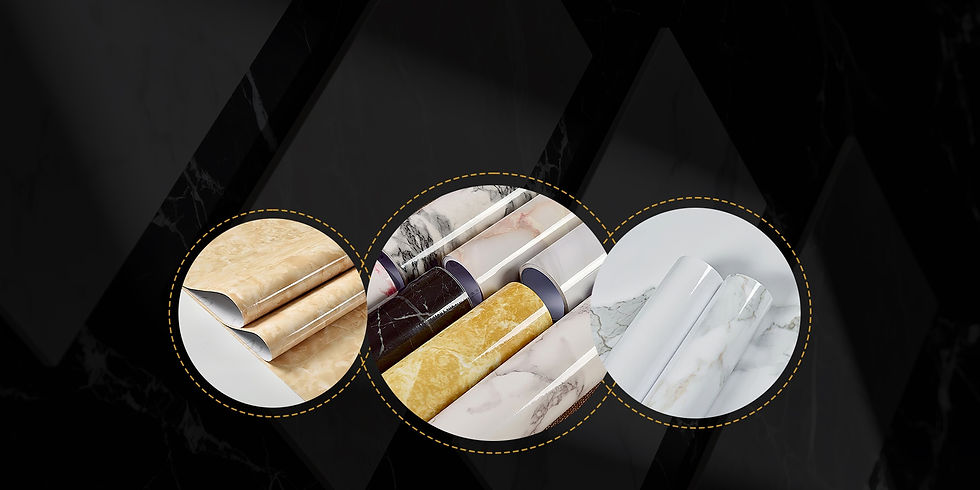
2) Marble / Stone Lamination Film
Look & pattern: Veining, mineral depth, polished or honed look (white marble, gray stone, travertine vibe).Best for: Table tops, coffee tables, vanity panels, cabinet accents, wall panels.Why it works: “Luxury surface” impression without the weight, lead time, or cost of real stone.
3) Fabric / Linen Texture Film
Look & pattern: Woven texture, soft matte finish, low glare under listing photography.Best for: Wardrobes, cabinetry accents, display back panels, wall paneling, retail fixtures.Why it works: Adds texture without visual noise; great when you want a calm, modern background for staging.

4) Metallic Decorative Film
Look & pattern: Brushed metal lines, satin sheen, industrial-clean vibe (champagne, silver, gunmetal).Best for: Appliance panels, trims, feature strips, elevator/column wraps, retail counters.Why it works: Makes spaces feel “newer” fast—ideal for hospitality suppliers and commercial fit-outs.

5) Solid Color Matte / Soft-Touch Film
Look & pattern: Clean color blocks, matte or fingerprint-friendly soft touch.Best for: Doors, base cabinets, desks, chairs, retail fixtures, wall panels.Why it works: The fastest reset for mismatched finishes—reads minimal, modern, and intentional.

Purchasing Checklist
Use the checklist below to reduce surprises—especially if you need low MOQ, fast delivery, and reliable results across multiple installs.
Checklist item | What to confirm (ask for it in writing) | Why it matters (stagers + B2B) | Quick rule of thumb |
Minimum Order Quantity (MOQ) | MOQ per color/pattern, and whether mixed patterns are allowed | Avoid overbuying; enables small “trial upgrades” | Prefer low MOQ for staging; scalable MOQ for distributors |
Delivery time | Sample dispatch time (e.g., “48-hour samples”), production lead time, shipping method | Keeps staging timelines predictable; avoids project delays | Validate sample speed + realistic ETD/ETA |
Roll width | Available widths and matching trims/edge solutions | Doors/cabinets need the right width to reduce seams | Choose widths that cover door/cabinet faces with minimal seams |
Adhesive type / install method | Self-adhesive (PSA), heat-activated, or non-adhesive lamination for press routes | Wrong method = bubbling, lifting, or factory workflow mismatch | Pick the method that matches your install process |
Surface compatibility | Approved substrates (painted wood, MDF, laminate, metal), prep requirements | Prevents failures on textured, chalky, or oily surfaces | Smooth + clean + stable surfaces = best results |
Warranty & claims process | Coverage scope, claim window, required evidence (batch/lot, photos, samples) | Makes risk manageable for contractors and distributors | A clear process is a quality signal |
Testing & documentation | What reports/declarations exist per SKU, and whether third-party | Helps approvals for hospitality/fit-out; supports compliance needs | Ask for SKU-specific documents, not generic claims |
Mini Case Study: “3 Doors + 12 Cabinet Doors in One Weekend”
Project snapshot
A home decorator needed a fast upgrade before photos for a mid-range listing: 3 interior doors (dated glossy wood) and 12 cabinet doors (yellowed, mismatched tones).
Film choice (what they used and why)
Doors: Matte wood grain decorative film (light oak tone) to remove the “orange” look and add warmth on camera.
Cabinets: Matte solid color soft-touch film (warm greige) to unify the kitchen and reduce glare.
Timeline (how it fit into a weekend)
Friday night: Measure, choose direction of grain, label each door/cabinet panel.
Saturday: Surface prep + primary installation (largest faces first).
Sunday: Edge finishing, hardware reinstall, final wipe-down, photo styling.

Testing + Documentation: What You Should Request, How to Verify It, When Third-Party Applies
If you’re a fit-out contractor, hospitality supplier, or distributor, don’t accept vague statements like “certified” or “tested.” Ask for SKU-specific documentation and verify it.

What we can provide (typical document set; availability can vary by SKU)
Product Data Sheet (PDS): thickness, finish, roll width options, recommended substrates
Installation Guide: prep, squeegee/heat guidance, edge finishing, post-install care
SDS/MSDS: material safety documentation for handling and project files
Compliance declarations (as applicable): REACH/RoHS declarations; region-specific statements if required
Performance reports (as applicable): water resistance / stain resistance / dimensional stability; fire testing reports when required for project specs (often handled as third-party)
How buyers verify documentation (fast and professional)
Match product code/SKU on the document to your purchase order.
Check test method name, report date, lab name, and sample identification.
For third-party reports, request the full PDF (not screenshots) and confirm the lab details via official channels.

Educational compliance resource (authority link)
For a plain-language overview of California Proposition 65 (useful when your products are sold into or within California), OEHHA’s official explanation is here: https://oehha.ca.gov/proposition-65/about-proposition-65. (OEHHA)(Prop 65 is a chemical exposure warning law tied to a published chemical list maintained by California.
FAQ
Can I apply lamination decorative film to textured doors?
It depends on texture depth. Light orange-peel can work with proper heat and pressure, but deep grooves often show through or reduce adhesion. For best results, use smooth, stable surfaces or prep (fill/sand/prime) when appearance matters.
How do I avoid bubbling during installation?
Common causes are dust, moisture, oil, and rushing. Clean thoroughly (degrease), work slowly with firm squeegee pressure, and use controlled heat to relax the film. Start from the center and push air out in consistent strokes.
What’s the fastest way to get a sample?
Send (1) the surface type (painted wood/MDF/laminate/metal), (2) preferred styles (wood/marble/metal/fabric/solid), and (3) roll width needs. Ask for 48-hour sample dispatch and confirm shipping method.
Will the film work on cabinets, tables, and doors the same way?
Not always. High-touch areas (cabinet edges, table corners) need better edge finishing and the correct construction/adhesive method. Share your use case so the recommended film structure matches your wear level.
What should I do if there’s an issue after installation?
Keep the lot/batch info, take clear photos (overall + close-up), and retain a small offcut. A professional supplier will have a defined warranty/claims workflow and help you identify whether it’s prep, substrate, or material-related.
Want a Low-MOQ Sample Plan for Your Next Door/Cabinet Refresh?
If you’re a US home stager, start with 3 sample directions: a neutral wood grain, a matte solid color, and a light stone—then test on your most visible surfaces (doors + main cabinet run).If you’re a distributor / fit-out contractor / hospitality supplier / furniture or door factory, ask for a project-based sample set aligned to your workflow (self-adhesive wrapping vs. press lamination routes).
Contact :Email: support@giwett.com
Phone/WhatsApp: +86 15738309271


Comments