
How to Choose the Right Lamination Decorative Film Supplier in Asia for Your Middle East WPC Door Projects
- Giwett

- Dec 11
- 7 min read
Introduction: Why Your Film Supplier Makes or Breaks Your Brand
If you’re running a PVC or WPC door factory in Saudi Arabia, UAE, Qatar, Kuwait, Oman, Bahrain, Iraq, or Egypt, you already know this:
The wrong lamination decorative film supplier can quietly destroy your profit, your reputation, and your repeat orders.
Typical complaints from Middle East door projects:
Doors start peeling or bubbling in less than 12 months.
White or light wood-grain films turn yellow in hot rooms or near windows.
Same design, different batch – the color and embossing don’t match.
Delivery time is unstable, making it hard to meet project deadlines.
Most of these problems are not caused by your WPC core. They come from film quality, film–substrate bonding, and supplier management. Choosing the right Asia-based lamination decorative film supplier is therefore a strategic decision, not just a price comparison.
This guide will help you, as a PVC/WPC door factory in the Middle East, build a clear checklist for selecting a supplier who can handle your climate, your door process, and your project demands.

Key Pain Points for Middle East PVC/WPC Door Factories
1. Climate resistance: heat, UV, and humidity
Middle East conditions are tough: high temperatures, strong sunlight, and indoor humidity. If the PVC decorative film is not engineered for this environment, you get:
Warping, bubbling, or cracking on the door surface
Yellowing of light colors and gloss loss
Faster aging of the adhesive and weaker bonding
Research on PVC film lamination to wood–plastic composites shows that film pretreatment and lamination conditions strongly influence bonding strength and long-term performance – exactly what you rely on in a WPC door.
2. Surface quality and bonding with WPC/PVC substrates
Even if your WPC door panel is strong, you can still get:
Bubbles due to dust or moisture trapped during lamination
Edge lifting because the film and adhesive are not optimized for your line
Print or emboss deformation at wrong temperature/pressure settings
A technically capable supplier understands that film, adhesive, and substrate form a system and will help you tune lamination temperature, pressure, and speed to your specific machines.
3. Design, color, and embossing fit for local taste
Middle East markets prefer:
Warm oaks, walnuts, ash grey, and off-white wood-grain films
Stone/marble looks for luxury doors
Modern solid colors for apartments and projects
If your supplier has a limited design library or keeps adjusting color formulas and embossing, your doors will look inconsistent across different projects and repeat orders.

4. Supply stability, compliance, and project risk
For project business (villas, apartments, hotels, offices), you need:
Stable lead time for bulk and repeat orders
Controlled MOQ that matches your stock strategy
Basic compliance documentation for PVC materials and surface durability (e.g., data related to VOC, abrasion resistance, and long-term performance).
To support your internal technical discussions, you can refer your team to neutral, technical resources such as:
These are purely educational and help your engineers talk more professionally about laminates and surface films.
What to Look For in an Asian Lamination Decorative Film Supplier
1. Climate-ready performance for Middle East conditions
Your supplier should clearly explain which lamination decorative film grade is suitable for:
Bedrooms and living rooms (normal indoor conditions)
Kitchens and bathrooms (heat, moisture, cleaning chemicals)
Doors near balconies or windows (higher light and temperature)
Ask for:
Test data on heat and UV resistance – how the film behaves under accelerated aging, heat, and light exposure.
Information on adhesion tests between PVC film and WPC/PVC substrates.
If they cannot show any performance data, they are asking you to experiment on your own projects – with your money and your customers.
2. Proven compatibility with your WPC/PVC door production
You want a supplier who already works with WPC door factories and understands:
Membrane/vacuum pressing vs. flat lamination vs. wrapping
Recommended temperature, pressure, and feed speed for each film type
How surface preparation (cleaning, sanding, dust removal) affects bonding
A serious supplier can provide:
A recommended process sheet for each film grade
Online or on-site support during trial runs
Quick troubleshooting if you see bubbles, orange peel, or edge lifting
This level of cooperation turns the supplier into a technical partner, not just a film seller.
3. Design library, customization, and color consistency
Your door design is your brand. Look for suppliers who offer:
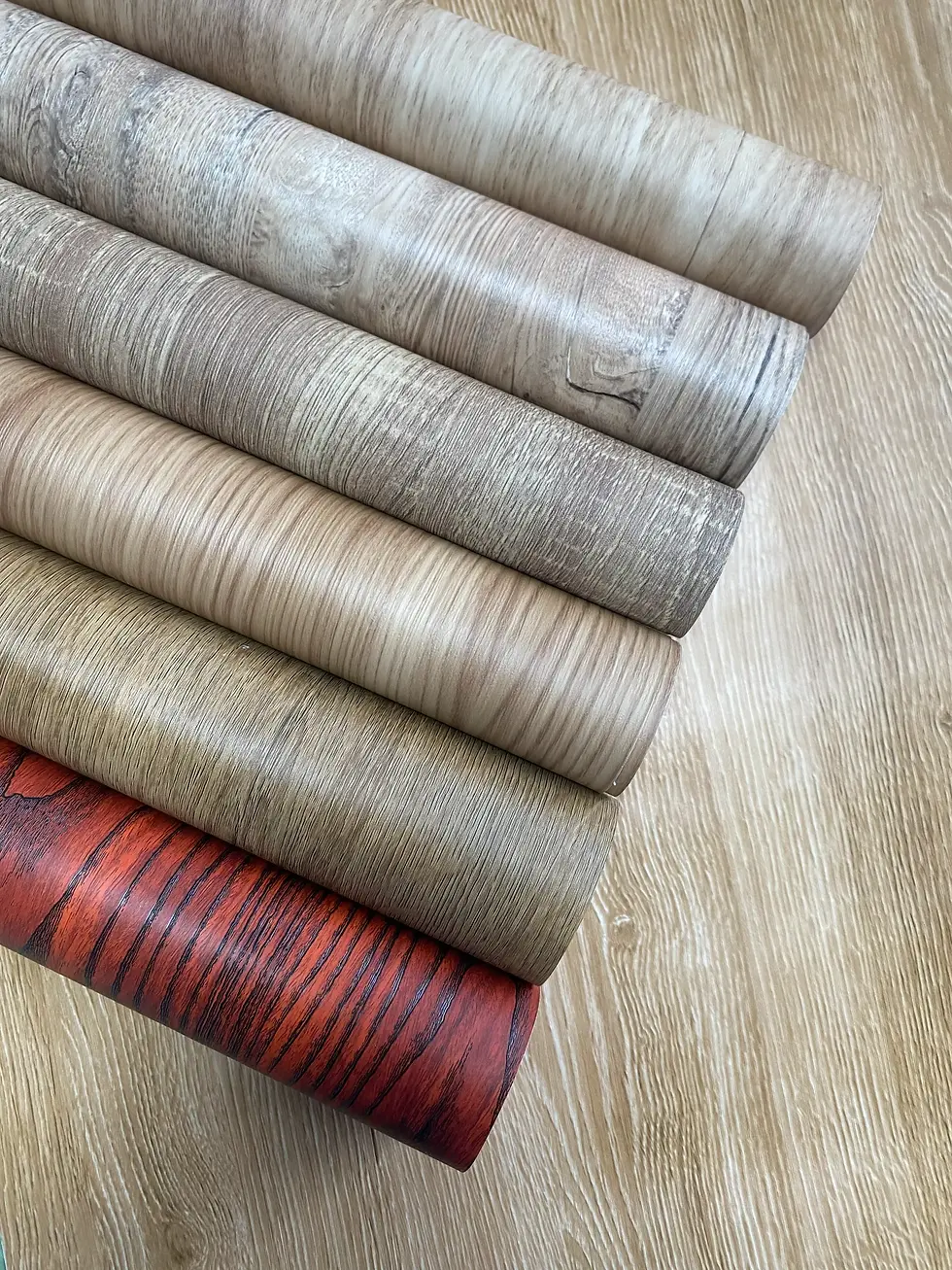
A broad catalog of wood-grain, marble, and solid-color PVC decorative film
Multiple embossing options (deep wood pore, fine texture, high gloss, super matte)
The ability to lock a color code for your best-selling designs and reproduce it stably over time
This is crucial when you supply:
Ongoing villa or apartment phases (Phase 1, Phase 2, Phase 3…)
Long-term contracts for specific door series
Ask how they manage color and embossing consistency between batches and over long periods.
4. Capacity, lead time, and MOQ that match project business
Middle East projects are often urgent. You need an Asian supplier who can:
Offer flexible MOQ for new colors and trial items
Keep regular designs in stock or produce them predictably
Support a realistic delivery window that fits your shipping schedule
Suppliers with multiple production lines and a stable planning system are better positioned to protect you from delays and material shortages.
5. Service, samples, and long-term partnership
Good suppliers make it easy for you to grow:
Sample lead time: can they send catalogs and rolls quickly so your team can test?
Problem-solving attitude: how do they handle claims or quality issues?
Market understanding: do they know which designs sell in Riyadh, Jeddah, Dubai, Doha, Baghdad, etc.?
Over time, the right partner will:
Remember your best-selling door designs
Adjust production and stock planning for your peak seasons
Proactively suggest new film designs that match Middle East tastes
Supplier Evaluation Checklist (Comparison Table)
Use this table in internal meetings and supplier calls. It helps your purchasing, production, and quality teams speak the same language when evaluating lamination decorative film suppliers.
Evaluation Point | Why It Matters for Middle East WPC Doors | Questions to Ask Your Lamination Decorative Film Supplier |
Film grade & thickness (e.g., 0.12–0.45 mm) | Impacts strength, touch, and scratch resistance on door surfaces | What thickness and grade do you recommend for interior WPC doors in hot climates? |
Heat & UV resistance | Prevents warping, fading, and yellowing in high-temperature, high-light areas | Do you have test data showing performance under heat and UV exposure? |
Adhesion & bonding performance | Poor bonding leads to peeling and warranty claims | How do you test adhesion to WPC/PVC substrates? Which adhesive systems do you prefer? |
Color consistency & batch control | Ensures same look across multiple batches and project phases | How do you control color and embossing from batch to batch? |
Design & embossing range | Defines how attractive and competitive your door designs can be | Can you provide a full catalog of wood-grain, marble, and solid colors for our market? |
MOQ and lead time | Affects stock risk, cash flow, and ability to react to new projects | What is your standard MOQ per color? What is your lead time for repeats and customs? |
Certifications & compliance | Required by larger developers and export markets | Which test reports and certifications can you provide for your PVC decorative films? |
Technical & after-sales support | Reduces scrap rate and speeds up problem resolution | Who is our technical contact? How do you support us if we have lamination issues? |
FAQ: Practical Questions from Middle East PVC/WPC Door Factories
Q1: How long should lamination decorative film last on WPC doors in the Middle East?
In normal indoor applications (bedroom, living room, interior corridor) with professional lamination and proper cleaning, high-quality PVC decorative film can typically deliver a service life of around 6–10 years before clear signs of aging, such as color fading, gloss loss, or surface micro-cracks. (pvcdecorativefilm.com)
However, the real lifetime depends on:
Room conditions (temperature, sunlight, humidity)
Film grade and thickness
Adhesive system and process parameters
Cleaning chemicals used by end customers
For doors exposed to stronger heat and light (e.g., near balcony doors or in very hot kitchens), it is safer to select a higher-grade film and to manage customer expectations closer to the lower end of that range.
Q2: What is the best thickness of lamination decorative film for interior doors?
For PVC/WPC interior doors, most suppliers offer 0.12–0.45 mm PVC lamination films. (Qisheng)
A practical guideline:
0.12–0.20 mm:
Suitable for standard interior doors in low- to medium-traffic areas
Good for cost-sensitive projects and economy series
0.25–0.35 mm:
Better for higher-traffic or higher-value doors (e.g., main bedroom doors, hotel rooms)
Feels more solid, often with better emboss and scratch resistance
Above 0.35 mm:
Used when you need very strong surface presence or specific technical performance
For most Middle East residential projects, a balanced choice is 0.16–0.25 mm, adjusted according to your door price segment and target customer.

Q3: How should we test a new lamination decorative film before mass production?
Before you approve a new film from an Asian supplier, run a controlled trial:
Small-scale line test
Laminate a limited number of door skins using the supplier’s recommended temperature, pressure, and speed.
Visual and touch inspection
Check for bubbles, orange peel, pinholes, color difference, and surface defects.
Simple adhesion checks
Do cross-cut or peel tests at room temperature and after a heat cycle (for example, storing samples in a warm room or under sunlight for a few days). (皇家化学会出版物)
Cleaning and scratch tests
Wipe with common detergents and perform light scratch tests to simulate real use.
Internal approval
Let sales, production, and QC teams sign off together, especially if the film will be used in a high-volume project.
This method helps you avoid large-scale problems and builds confidence in both the film and the supplier.

Q4: Can one film grade work for all door types (bedroom, bathroom, kitchen, balcony)?
Technically, one lamination decorative film grade can be used everywhere, but it is rarely the best business decision.
For optimal performance and cost control:
Use standard indoor-grade film for bedroom and living room doors.
Consider higher-grade, more heat- and moisture-resistant film for kitchens and bathrooms.
For doors heavily exposed to sunlight or heat, choose a grade with better UV and thermal stability, even if the cost per meter is slightly higher. (浙江美顺达)
By matching film grade to door location, you reduce complaints and avoid over-spending on unnecessary performance.

Conclusion
Choosing the right lamination decorative film supplier in Asia is about much more than getting a low price per meter. For Middle East PVC/WPC door factories, the “right” supplier is one who can:
Deliver climate-ready films that handle heat, UV, and humidity
Ensure strong, stable bonding to WPC/PVC door substrates
Provide the designs, colors, and embossing your market loves
Offer reliable lead times, flexible MOQ, and technical support
Use the checklist and FAQ in this article as your internal tool. Shortlist two or three potential suppliers, share your door specifications and target markets, and run small, controlled trials before committing to large projects.
Next step:
Create a simple comparison sheet using the table above.
Talk to your current or potential Asian suppliers using these questions.
Select the partner who not only sells film, but also helps you reduce complaints, win more tenders, and build a strong WPC/PVC door brand across the Middle East.


Comments